
Erasmus+ 2028-2034: Council Proposal Puts the Programme at €34.7 Billion
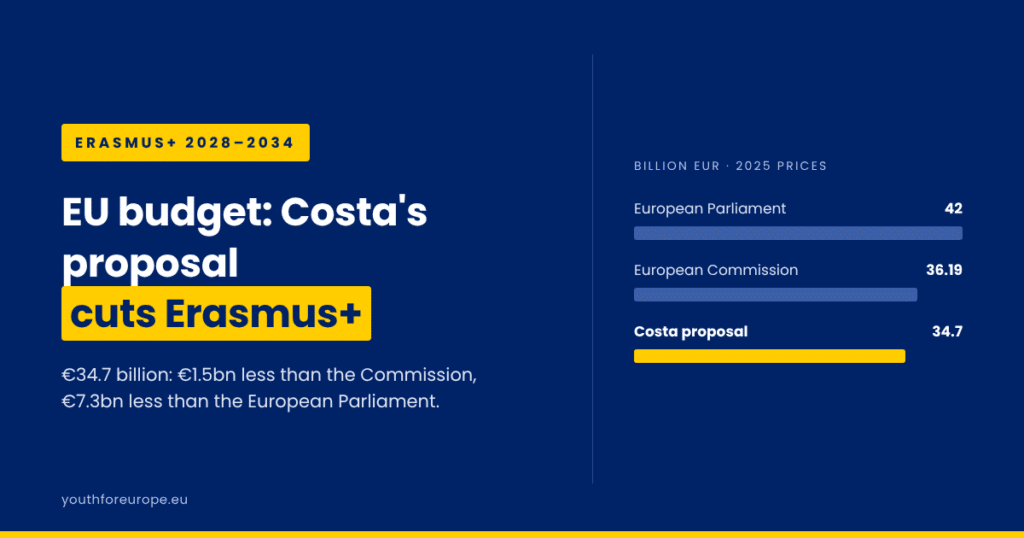
On 21 November 2026, European Council President António Costa presented his proposal for the EU’s 2028-2034 budget. It sets Erasmus+ at €34.7 billion in 2025 constant prices: €1.5 billion less than the European Commission proposed, and more than €7 billion less than the European Parliament is asking for.
The figure is not final. It is the starting point for EU leaders at the special European Council on 26-27 November. But it shows where member states are heading: an Erasmus+ bigger than today’s, yet smaller than Brussels proposed and MEPs want.
The figures compared
Compared like for like, Costa’s proposal is €1.5 billion below the Commission and about €7.3 billion below Parliament. EU budget figures come in two versions: constant 2025 prices (without inflation) and current prices (including expected inflation up to 2034).
- European Commission (16 July 2025): €36.19 billion in constant prices, €40.8 billion in current prices.
- European Parliament (22 October 2026): €42 billion in constant prices, €47.38 billion in current prices.
- Irish Council Presidency (10 October 2026): €39.165 billion in current prices.
- Costa’s proposal (21 November 2026): €34.7 billion in constant prices, about €39 billion in current prices.
A word of caution: the €34.7 billion is in constant prices, while €40.8 and €47.38 billion are in current prices. Putting them side by side makes the gap look bigger than it is (€6.1 and €12.68 billion). On the same basis, the cut is €1.5 billion against the Commission and about €7.3 billion against Parliament.
For the budget as a whole, Costa proposes €1,582 billion in constant prices: €181 billion less than the Commission, about 10%. In current prices the reduction is €204 billion (Eunews).
The context: a new Erasmus+ from 2028
The next Erasmus+ will run for seven years, from 2028 to 2034, funded by the new Multiannual Financial Framework (MFF), the EU’s long-term budget.
- 16 July 2025. The Commission presents its proposal for an MFF of almost €2 trillion and the new Erasmus+ regulation, with €40.8 billion: +49% compared with the 2021-2027 programme.
- The new programme absorbs the European Solidarity Corps. Volunteering and solidarity projects move into Erasmus+. Parliament wants the Corps to keep its visibility (EPRS).
- June-October 2026. The Cypriot and Irish Council Presidencies table the first negotiating boxes with figures: both set Erasmus+ below the Commission’s proposal.
- 22 October 2026. The European Parliament adopts its Erasmus+ mandate by 454 votes to 34, with 93 abstentions, calling for €47.38 billion.
Even under Costa’s proposal, the Erasmus+ budget would be higher than today’s. The debate is about how much it should grow, and how many young people it can reach.
The reactions
The proposal got a cool reception from both Parliament and the Commission, and civil society is calling for Erasmus+ to be protected.
- European Parliament. Siegfried Mureșan (EPP), co-rapporteur on the budget, called it “simply unacceptable”, saying the Council is “fixated on cuts” (EU Perspectives). The final budget needs Parliament’s consent.
- European Commission. Spokesperson Balázs Ujvári said Brussels regrets that successive negotiating boxes have brought substantial cuts, and that a deal by year-end is crucial to secure funding from 1 January 2028.
- Erasmus+ Coalition Italy. The Italian network called it “a step backwards”, stressing that Erasmus+ is one of the ways the EU reaches people’s and organisations’ everyday lives.
- Students. The European Students’ Union had already criticised the Cypriot and Irish figures, arguing that demand for Erasmus+ already exceeds available funding (ESU).
What happens next
The next step is the special European Council on 26-27 November 2026 in Brussels, where leaders will try to reach a deal based on Costa’s proposal.
- Agreement among the 27. The MFF must be adopted unanimously by the Council, together with new own resources (Costa proposes five, including digital services, CBAM and tobacco).
- Parliament’s consent. MEPs have called for a budget 10% higher than the Commission’s proposal.
- Negotiations on the Erasmus+ regulation. The file has been referred back to the CULT committee, which will negotiate the 2028-2034 programme text with the Council.
- Final figure. The final Erasmus+ envelope will depend on the MFF deal. The aim is to conclude in time for the programme to start on 1 January 2028.
What about going abroad now?
Nothing changes for now: the negotiations concern the programme starting in 2028. Youth exchanges, training courses and European Solidarity Corps projects planned for 2026 and 2027 are funded by the current budget.
What is decided in these weeks matters for those who will go later: less funding means fewer approved projects and fewer places. We will keep following the negotiations and keep you updated.
In the meantime, you can find open opportunities to go abroad on youthforeurope.eu.
Sources
Official:
- Council of the EU – Multiannual Financial Framework, President Costa’s proposal (21/11/2026)
- Council of the EU – The EU’s long-term budget 2028-2034
- European Commission – Proposal for the Erasmus+ 2028-2034 regulation, COM(2025) 549
- European Parliament, Legislative Observatory – procedure 2025/0222(COD)
- EPRS – Plenary session October II 2026, Erasmus+
- European Parliament – Position on the 2028-2034 budget